


The Wonderful, Horrible Countryside housing experiments were carried out in nine locations in Northern Satakunta and Northwestern Pirkanmaa during the autumn of 2025. These week-long everyday test periods offered a concrete opportunity to find out what life in the countryside would really feel like – from the perspective of one's own wishes, needs and dreams.
The Ihana kamala maaseutu concept approached those dreaming of moving to the country with bold claims in its advertising slogans: The countryside is not for everyone. Would it be for you? The aim was to find just the right people for the housing experiments, who are ready to throw themselves into rural life for a week and make the most of the trial week.
Finding work in rural areas had previously been identified as a particular obstacle to moving to the country, so initially people were sought for whom remote work is already part of everyday life. A total of 223 applications were received, of which 20 different groups of housing experimenters ended up in the trials.
The aim was to present the countryside of Northern Satakunta and Northwest Pirkanmaa without embellishment, so the time chosen was an everyday autumn day. Accommodations, hobbies, company visits and encounters with locals were tailored for the participants according to what each person expects from everyday life.
"There was one clear goal behind it: to lower the threshold for moving to the country. The housing experiments were built around real life, offering a realistic view of everyday life in new places of residence," says project manager Noora-Mari Syväluoma.
More than a trip – a living experiment opened the door to everyday life
The residential experiments differed significantly from ordinary rural tourism. Where a casual tourist sees the village superficially, the resident experimenter gets to briefly participate in real everyday life: on the edge of the kindergarten sandbox, during a teaching moment in schools, on an evening jog on the fitness track, at an association evening and at a church concert with other local residents.
“The experimenters got to peek behind the scenes – not just see, but feel what life would really feel like if this were permanent,” says project coordinator Noora Elonen.
They met with the residents of the municipality face to face, sat at the same coffee table with the villagers and considered small but meaningful everyday choices from the perspective of their own lives: where to work remotely, what hobbies to do, how to get around, and who are the people with whom they would share their everyday lives.
Based on feedback, the housing experiments met – and often exceeded – the participants' expectations.
“One of the biggest benefits we noticed was how diverse services and hobbies can be just around the corner, even though the municipality only has a few thousand residents,” says Elonen.
The housing experimenters were fascinated by the local schools and daycare centers, where class sizes are small and teachers know the entire school's students by name.
Nature and its accessibility became a recurring theme. You could go to the forest, lean-to or go for a run right from your door – and there was no rush or traffic. The silence, clean air and starry sky seemed to many experimenters to be a powerful counterbalance to the rhythm of the city.
The community spirit of the municipalities and the openness of the people also made an impression. Local residents welcomed the housing experimenters genuinely and with open arms, invited them to their homes for coffee, told them about their everyday lives and made living in the area a reality. Discussions arose at coffee tables, evening walks, concerts and village coffees.
“The discussions with the municipal leaders were highly praised, as they created a feeling of easy approach and opportunities for local residents to have an impact,” says Elonen.
What can we learn? Perspectives on municipal marketing and promoting migration to the countryside
From the perspective of the municipalities, the experiments were not only a visible but also a meaningful form of vitality work. Organizing the experiments required resources and cooperation, but they also created a completely new way of marketing the locality and building bridges with potential migrants.
The housing experiments also provided valuable information about the obstacles and opportunities for migration to the country. The clearest lessons and observations can be summarized as follows:
1. The threshold is not a lack of interest – but practical uncertainty. Many people dream of moving to the country, but are afraid that everyday life won't work out. The experiments answered exactly this: they gave them permission to test and explore safely without being forced to buy.
2. Services must be highlighted in the context of everyday life. It is one thing to tell people that there is a school in a municipality, and another to take a family to a classroom in the middle of everyday life. Schools, daycare centers, sports facilities, and remote work opportunities make an impression – especially if you can try them out yourself. These should be prominently featured in municipal communications.
3. Real people, not just pictures and advertising slogans. Encounters build an image. People make a place. One warm conversation can carry more weight
than ten advertising slogans. Therefore, the contribution of the municipality's personnel, companies and associations was worth its weight in gold.
4. A truly lived everyday life is more interesting than a polished surface. The darkness, the slush, and the grayness of everyday life did not discourage them – they brought credibility. City dwellers are not attracted by the polished cottage life, but by the opportunity to see what their own everyday life would really look like in the countryside.
"Housing experiments are also an excellent tool for developing municipal marketing. They generated content, stories and recommendations that can be utilized across multiple channels. At the same time, municipalities were given the opportunity to look at themselves through the eyes of an outsider and discover strengths that they don't always see themselves," Syväluoma recalls.
Steps towards new beginnings
The concept of the wonderful, terrible countryside struck a chord with the times. It doesn't try to sell an idyll. It doesn't claim that life in the country is perfect for everyone, but it offers an honest opportunity to try. And for those willing to swap their busy commutes for a cup of coffee in the warmth of a wood stove, this could be the start of something big.
“For many, the week was not just an experiment, but a turning point. The housing experiments clearly lowered the threshold for many participants to consider moving to the country. Many said that the concrete experience was a decisive step. For many, the week was also a question of identity: Would I be a country dweller and do I belong here?” say Syväluoma and Elonen.
The housing experiment proved to be an effective way to strengthen the attractiveness of municipalities, arouse interest and dispel prejudices about the countryside. The power of the "Ihana humala maesutu" housing experiments lies in the cooperation and shared visibility of nine municipalities.
The housing experiments were not a typical municipal marketing exercise, but as such a bold and distinctive implementation, they were quite effective. The municipalities of North Satakunta and Northwest Pirkanmaa left an emotional mark on the experimenters that can only be achieved through genuine encounters and incredibly wonderful everyday life.
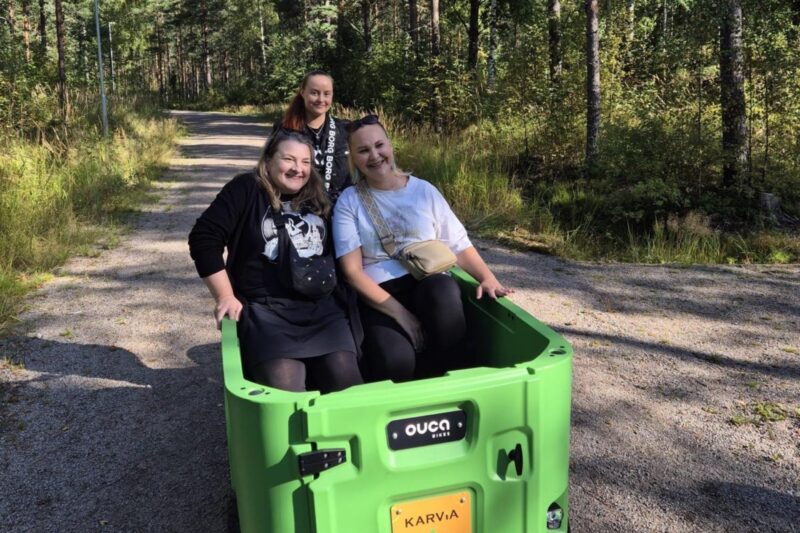
Karvia housing experiment: Karvia housing experimenters enjoy a wild ride in Karvia, jumping on the Kyläluuta bike. Photographer Tarja Hosisasluoma
More information about the project
The housing experiments were carried out as part of the Network for Attracting People cooperation project managed by Leader Pohjois-Satakunta, which is a joint rural vitality development project of nine municipalities. The project is co-financed by the European Union's Rural Development Fund, and the project period is 1 January 2024–30 June 2026.
More information about upcoming housing experiments can be found on the website ihanakamalamaaseutu.fi and on Instagram @ihanakamalamaaseutu.
Contact persons
Project Manager Noora-Mari Syväluoma
Leader North Satakunta, Networking for Attraction - cooperation project noora-mari.syvaluoma@kankaanpaa.fi
040 190 9440
Project coordinator Noora Elonen
Leader North Satakunta, Networking for Attraction - cooperation project
noora.elonen@kankaanpaa.fi
040 577 1300